
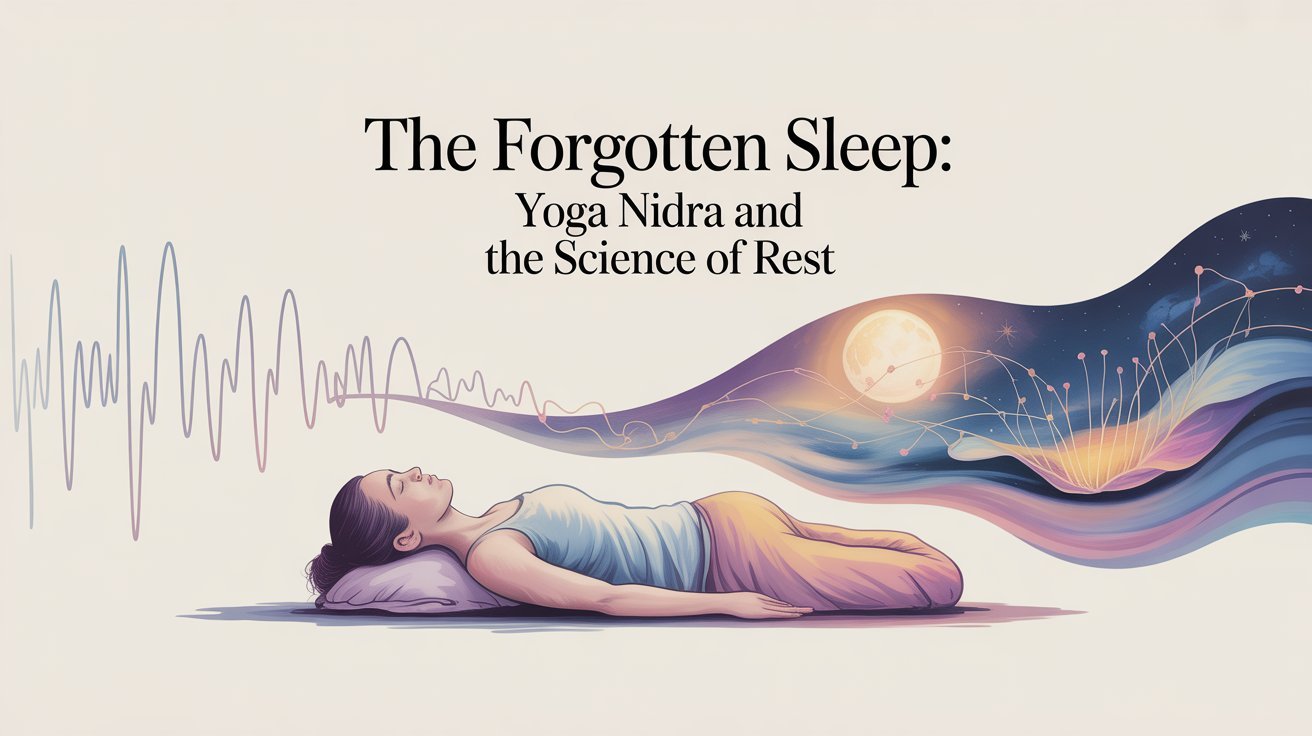

The Forgotten Sleep: Yoga Nidra and the Science of Rest
Sleep is the most natural medicine available to human beings, yet it is the one most often ignored. We try to replace it with caffeine, motivation, or productivity hacks, forgetting that true performance begins with recovery.
Modern research and ancient yogic knowledge agree on one truth: rest is not laziness, it is renewal. When rest disappears, balance follows it out the door. Insomnia, anxiety, and emotional fatigue are only symptoms of a deeper disconnect.
Yoga Nidra, often called yogic sleep, is a method to restore this lost connection. It bridges the conscious and subconscious mind, bringing the body into deep rest while keeping awareness awake. At YOGNAYUR, it is used as part of WellnessBridge programs to rebuild focus, resilience, and emotional stability in the modern mind.
What Is Yoga Nidra
Yoga Nidra is a guided relaxation practice where the body sleeps, but the mind remains aware. The name literally means “sleep with awareness.” Unlike ordinary sleep, Yoga Nidra is conscious rest. It is practiced lying down, allowing both the body and mind to reset together.
During Yoga Nidra, practitioners move through different stages of relaxation. These include body awareness, breath observation, visualization, and affirmation. Each stage brings the nervous system deeper into calm.
The result is a state between waking and sleeping, where the brain releases tension and rebalances hormones. Scientists refer to this as the hypnagogic state. In this condition, alpha and theta brain waves dominate, leading to profound mental recovery.
How Yoga Nidra Differs from Regular Sleep
Regular sleep refreshes the body, but Yoga Nidra renews the body and mind simultaneously. In normal sleep, the mind remains semi-active, processing memories and emotions. In Yoga Nidra, mental chatter pauses completely, and the body enters a state of deep physiological rest.
Here is a clear comparison:
| Regular Sleep | Yoga Nidra |
| Involuntary and unconscious | Voluntary and conscious |
| Mind may still process stress | Mind becomes detached and observant |
| Refreshes body but not always emotions | Heals both body and emotions |
| Difficult to guide intentionally | Can be practiced anytime with awareness |
Through this conscious rest, Yoga Nidra helps rebuild what the modern world constantly drains: inner silence.
The Science of Deep Rest
In recent years, researchers have begun studying the physiological impact of Yoga Nidra. EEG and MRI scans show that it shifts brain activity from beta waves (associated with alert thinking) to alpha and theta waves (linked to creativity, calm, and intuition).
This brain-state shift slows heart rate, balances hormones, and triggers the body’s natural healing processes. Cortisol, the stress hormone, decreases, while melatonin production improves, leading to better sleep cycles.
A study published by the Indian Journal of Physiology and Pharmacology found that a 30-minute Yoga Nidra session provided equivalent rest to several hours of regular sleep in terms of nervous system recovery.
Such evidence shows why ancient Yogis considered Yoga Nidra a doorway to true restoration, not a substitute for rest but a way to make rest conscious.
How Yoga Nidra Supports Mental Health
The mind is rarely silent. Even in quiet surroundings, thoughts continue their restless motion. Over time, this constant activity leads to anxiety and exhaustion. Yoga Nidra works as a natural antidote.
During practice, attention is moved systematically through the body and breath. This draws awareness away from worries and activates the parasympathetic nervous system, which is responsible for relaxation.
Practicing Yoga Nidra regularly can:
- Reduce symptoms of anxiety and insomnia
- Improve concentration and creativity
- Enhance emotional regulation
- Support recovery from burnout
- Increase resilience against stress
At PragyaEdu, students and professionals are taught Yoga Nidra as a part of self-management modules. It is not a luxury but a life skill that trains the nervous system to respond rather than react.
How to Practice Yoga Nidra at Home
Yoga Nidra does not require equipment or experience. All you need is a quiet space, a mat or soft surface, and a few minutes of uninterrupted time.
Step-by-step guide
- Find a calm space. Lie down comfortably on your back with arms slightly away from the body.
- Set an intention. Mentally choose a simple, positive resolve such as “I am calm and balanced.”
- Rotate awareness. Move attention slowly through different parts of your body, from toes to head.
- Observe your breath. Feel the natural rhythm without changing it.
- Visualize relaxation. Imagine warmth spreading through the body like sunlight.
- Return gently. When guided practice ends, slowly bring awareness back to your surroundings.
For beginners, audio guidance or in-person sessions available through WellnessBridge can help ensure correct practice and deeper results.
When and How Often to Practice
Yoga Nidra can be practiced at any time of the day, but it works best in the early morning or before sleep at night. A fifteen to thirty-minute session is enough to restore energy.
Many professionals integrate a short midday session during lunch breaks to refresh their focus. Unlike meditation, Yoga Nidra requires no mental effort. You simply lie down and follow the voice or inner awareness.
Practicing it three to four times a week can significantly improve mental and emotional health. Within a few weeks, people report better sleep quality, lighter moods, and reduced fatigue.
Why Rest Is the Future of Wellness
In a culture that values constant activity, rest has become revolutionary. Sleep deprivation is linked to every major lifestyle disorder, from hypertension to mood disorders. Relearning to rest consciously is not optional anymore.
Yoga Nidra teaches the art of conscious recovery. It helps us use awareness to rest fully, not partially. The nervous system, when regularly restored through such practices, becomes more adaptable, focused, and creative.
At YOGNAYUR, rest is treated as a foundational practice. Through WellnessBridge, corporate teams use Yoga Nidra sessions to reset their energy and clarity. Through PragyaEdu, students learn how awareness-based rest can prevent burnout.
Health is not achieved by working harder but by recovering better.
Living the Art of Stillness
Stillness is not the absence of movement; it is the mastery of it. In moments of deep rest, the body remembers its intelligence and the mind returns to peace.
Yoga Nidra helps you rediscover that silence within the noise. With time, the practice moves beyond the mat. You begin to carry stillness into meetings, conversations, and everyday life.
The forgotten sleep becomes a living meditation, a state where doing less creates more balance.
A Thought to Reflect On
“When you rest, you are not wasting time. You are returning to yourself.” – Yogi Proverb